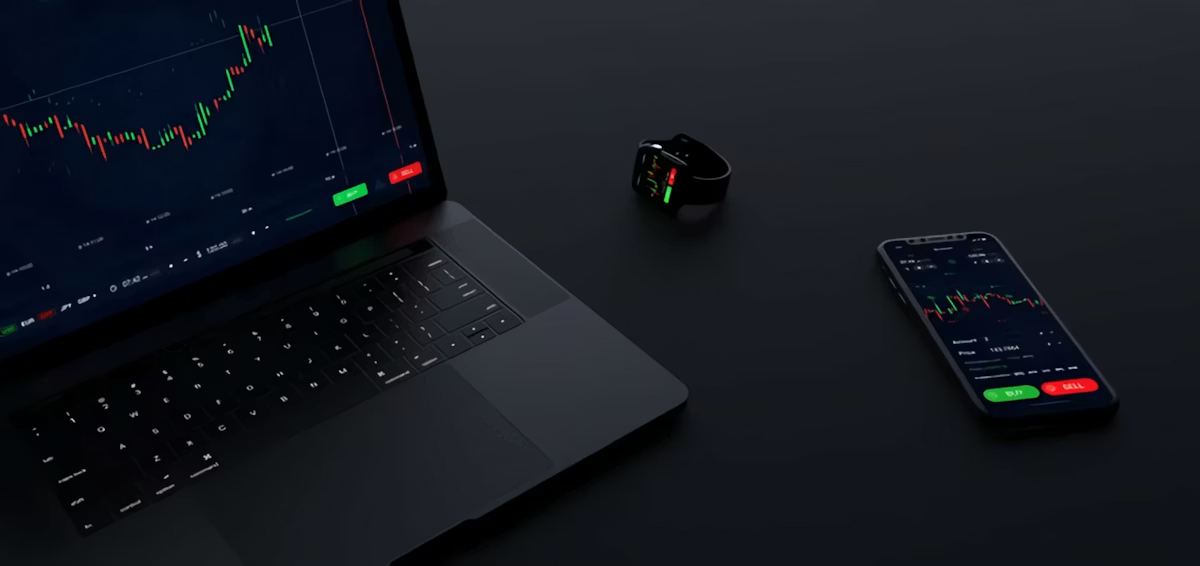
For decades, the "information gap" stood as the primary barrier between individual investors and meaningful market insight. Institutional desks ran dedicated servers to parse global data in real time. Retail participants, by contrast, worked with delayed newsfeeds and static charts that told them where the market had been, rarely where it was headed.
That landscape is shifting in a meaningful way. The integration of high-performance analysis modules, often marketed under the banner of "AI trading tools," has moved from experimental labs into standard platform features. These systems are designed to categorize massive datasets at speeds no human analyst could match, surfacing signals that would otherwise stay buried in the noise.
The change is not cosmetic. Platforms that once differentiated themselves on spreads and asset counts are now competing on the depth of their analytical infrastructure. The question for investors is not whether these tools exist, but how to evaluate them critically.
Moving beyond predictive claims
Compliance and transparency have moved to the center of the conversation around analysis tools. Serious providers have stepped back from "guaranteed results" language, focusing instead on what is more accurately described as decision support. These systems are good at one specific thing: detecting structural anomalies in price action that may precede volatility. They do not predict the future. They surface patterns worth paying attention to.
The practical implication for retail investors is that these tools are most useful as a filter, not a strategy. They reduce the volume of information a trader needs to process manually. The judgment calls, the position sizing, the risk decisions, those remain the investor's responsibility.

Sentiment correlation / 24-hour simulated view
Figures are illustrative and based on simulated data. Past performance does not indicate future results.
The verdict: evolution, not revolution
The transition to what platforms are calling "intelligent trading environments" is better understood as a gradual improvement of the overall trading experience rather than a single breakthrough product. By handling the mechanical work of market scanning, these tools free retail investors to concentrate on what actually matters: strategy and risk control.
The providers that have done this well have focused on transparency. They tell users what the tools can and cannot do. They integrate risk disclosures into the workflow rather than burying them in terms documents. And they have structured their analysis features as supplementary to human judgment rather than a replacement for it.
For investors considering a platform upgrade, the practical checklist has not changed: verify the regulatory status, understand the full cost structure, and test the tools on a demo account before committing capital. Intelligent features are only as valuable as the platform they sit on.